











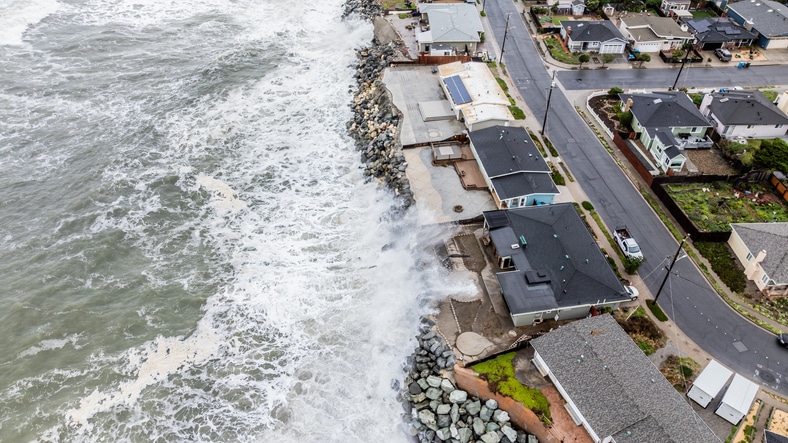
Rising sea levels could flood thousands of hazardous coastal sites by 2100 if greenhouse gases continue to accumulate in the atmosphere, according to a study published in Nature Communications. The research focuses on facilities and locations that contain or could release contaminants if floodwaters reach them. For insurance professionals, the findings provide new insights into the long-term risk landscape for coastal communities and infrastructure.
Key Findings on Site Exposure by 2100
The study warns that flooding could strike about 5,500 hazardous sites, potentially releasing contaminants if waters reach those areas. The greatest concentration of severe flood risk appears in seven states. Eighty percent of the highest-risk sites are located in Louisiana, Florida, New Jersey, Texas, California, New York, and Massachusetts.
Researchers examined hazardous sites across Puerto Rico plus 23 U.S. coastal states. They used historical sea level measurements and then projected future sea level rise under low- and high-emissions scenarios. Under the low-emissions scenario, the study found that 11 percent of sites would face flood risk. Under the high-emissions scenario, the projected exposure increases significantly across multiple categories of infrastructure:
- Over a fifth of coastal sewage treatment facilities, refineries, and formerly used defense sites are projected to be at risk by 2100.
- Roughly a third of power plants are projected to be at risk by 2100.
- Over 40 percent of fossil fuel ports and terminals are projected to be at risk by 2100.
Timing Could Accelerate in Mid-Century
While the study looks to 2100, it also highlights notable near-term acceleration. More than half of the hazardous sites identified could face severe flood risks much sooner, as early as 2050. The researchers attribute this earlier exposure to extreme coastal flooding that is expected to double by that year.
This timeline matters because it suggests that some coastal areas may encounter heightened flood conditions in the middle of this century, not only at its end. The research frames this as a shift in when high-severity risk becomes more common, rather than an isolated late-century problem.
Communities Identified as Most Vulnerable
The study links site exposure to social vulnerability. Researchers state that if floodwaters destabilize hazardous sites, affected neighborhoods could include communities described as “Hispanic, households with incomes below twice the federal poverty line, households without a vehicle, non-voters, and renters.”
The authors also note structural factors that influence flood risk patterns. They state that racial residential segregation and unequal distribution of stormwater infrastructure contribute to what they describe as racialized patterns of flooding across U.S. cities. In other words, the study suggests that current community and infrastructure conditions align flood exposure with existing social and demographic disparities in many places.
Potential Health Risks From Flooded Sites
The research points to possible health impacts when floodwaters reach certain industrial locations. University of Maryland professor Sacoby Wilson, speaking to The Associated Press and not involved in the study, said rising floodwaters could create health risks if industrial animal farms or sewage treatment plants are inundated. People near these waters could face exposure to bacteria like E. coli. Wilson added that floodwaters affecting industrial sites could expose chemicals associated with rashes, headaches, fatigue, and burning of the eyes.
He also said that flood events could worsen underlying health conditions for vulnerable individuals. This aspect of the study underscores the intersection between environmental exposure and public health during coastal flooding.
Study Purpose and Forward-Looking Approach
Lara J. Cushing, associate professor of environmental health sciences at the University of California, Los Angeles, and co-author of the paper, told the AP that the study aims to look far into the future so stakeholders can plan ahead. She said the goal is to “get ahead of the problem” by identifying what could happen under different emissions pathways.
Cushing added that the study indicates time remains to respond. She said stakeholders can work to mitigate risks and increase resilience in coastal areas before projected sea level rise and flooding reach the most severe levels.
Why These Projections Matter for Insurance Professionals
The study provides a broad, data-driven view of how sea level rise can create exposure at hazardous sites tied to core utility, industrial, and energy systems. It also identifies where those risks are most concentrated and when severe exposure may begin for many sites.
As sea levels rise and extreme coastal flooding increases, the research suggests that hazardous site flooding could become a more frequent feature of the coastal risk environment. In addition, the study highlights that many of the most exposed sites sit near communities described as socially vulnerable. Taken together, these findings outline a future scenario in which coastal flooding interacts with industrial contamination risks and community sensitivity over multiple decades.
Conclusion
The Nature Communications study projects that rising sea levels could flood approximately 5,500 hazardous coastal sites by 2100 under continuing high emissions. It finds the greatest severe flood risk clustered in Louisiana, Florida, New Jersey, Texas, California, New York, and Massachusetts. Moreover, it warns that more than half of these sites could face severe flood risks as early as 2050 due to a projected doubling of extreme coastal flooding.
Researchers connect these hazards to communities they identify as socially vulnerable and point to the role of segregation and uneven stormwater infrastructure in shaping flood patterns. External experts also note that flooded industrial and sewage sites could raise bacterial and chemical exposure concerns. The authors say the study is intended to support early, long-range planning so that risk mitigation and resilience measures can occur before projected impacts intensify.
Stay informed and ahead of the curve — explore more industry insights and program opportunities at ProgramBusiness.com.