











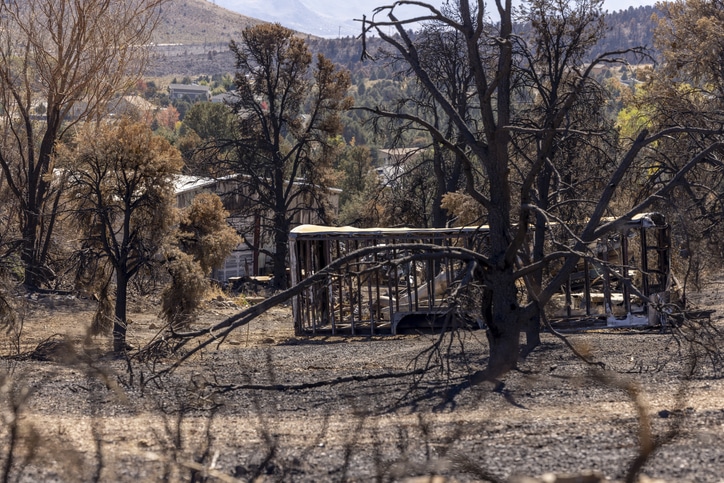
Beginning January 1, 2026, Nevada home insurers will be permitted to remove wildfire coverage from standard homeowners policies. The new law, passed by the Nevada Legislature this fall, clarifies that insurers have statutory authority to exclude wildfire losses while also allowing them to offer wildfire-only policies as standalone coverage.
For insurance professionals, the change formalizes a risk-segmentation approach that already exists in other catastrophe-exposed markets — and raises questions about whether similar pressures could eventually reshape wildfire coverage in neighboring states, including California.
How Nevada’s Approach Compares to Other States
In several states, certain high-severity risks have already been separated from standard homeowners policies due to escalating loss costs. Examples include:
• Earthquake coverage in California
• Windstorm coverage in coastal Texas and Florida
In these markets, homeowners seeking protection for excluded perils must purchase separate policies, often through state-created nonprofit insurers such as the California Earthquake Authority or the Texas Windstorm Insurance Association.
Nevada’s law effectively adds wildfire risk to this category. Unlike California, however, Nevada does not have a FAIR Plan or equivalent residual market mechanism already offering wildfire-only coverage.
California’s De Facto Two-Policy System
While California law currently prevents insurers from eliminating wildfire coverage outright, the market has already evolved toward a functional equivalent.
California maintains a statutory “standard fire policy,” which defines the minimum coverage residential insurers must provide. Because of this requirement, insurers cannot selectively remove wildfire coverage without legislative action.
That said, over the past five years, the California FAIR Plan — a state-created but privately operated insurer — has become one of the largest property insurers in the state. The FAIR Plan covers fire, lightning, and explosions, but excludes many standard homeowners’ protections, including:
• Liability coverage
• Water damage from burst pipes
• Other non-fire perils
Homeowners insured through the FAIR Plan must purchase a separate “difference in conditions” (DIC) policy to obtain broader coverage. Several major insurers offer DIC policies, and in 2024, State Farm General told some customers it would only renew coverage if fire protection was obtained through the FAIR Plan.
As of 2023, 207,728 California homeowners — roughly 2% of the market — carried both FAIR Plan fire coverage and a DIC policy, according to the California Department of Insurance.
Why Nevada Can Act — and California Cannot
Nevada does not have a standard fire policy statute. Even before the new law, insurers could technically file policy changes to adjust covered perils. According to Mark Sektnan, vice president of state government relations for the American Property Insurance Association, the new legislation simply provides explicit statutory protection for insurers that choose to remove wildfire coverage.
Insurers are not required to do so, and it remains unclear how many will. However, David Russell, a professor of insurance at California State University, Northridge, expects at least some carriers — particularly those with exposure in high-risk areas — to opt out of wildfire coverage, citing precedent from California’s earthquake market following the 1994 Northridge earthquake.
Market Pressures Already Emerging in Nevada
Although Nevada is not as wildfire-prone as California, the state’s Division of Insurance reported in 2025 that insurers have increasingly declined to write or renew policies in higher-risk areas such as Incline Village and Stateline. Allowing wildfire exclusions may give insurers greater flexibility to remain in the market rather than restricting underwriting entirely.
Absent this option, insurers facing excessive catastrophe risk often limit the number of policies they write or exit certain regions altogether.
The Role of Mortgage Lenders
One unresolved issue is how mortgage lenders will respond. While flood insurance is not included in standard homeowners policies, lenders require flood coverage in federally designated high-risk flood zones. A similar requirement could emerge for wildfire coverage in Nevada’s highest-risk areas.
However, there is no guarantee this will occur. In California, lenders typically do not require earthquake insurance, even in seismically active regions. Complicating matters further, wildfires are not confined to clearly defined high-risk zones.
Coverage Affordability and Protection Gaps
Consumer advocates warn that removing perils from standard homeowners policies can leave policyholders underinsured or uninsured. Amy Bach, executive director of United Policyholders, notes that homeowners already struggling with premium affordability may forgo supplemental coverage, increasing financial vulnerability after a loss.
As wildfire behavior continues to defy historical boundaries, the predictability of risk zoning — and the adequacy of coverage structures built around it — remains uncertain.
What Insurance Professionals Should Watch
Nevada’s wildfire law underscores a broader industry trend toward separating high-severity catastrophe risks from standard homeowners coverage. For insurers, agents, and regulators, key considerations include:
• Market participation versus coverage adequacy
• Consumer understanding of multi-policy structures
• Lender requirements and secondary market expectations
• Legislative appetite for redefining mandatory coverages
While California is unlikely to follow Nevada’s legislative path in the near term, its existing FAIR Plan structure demonstrates that similar outcomes can occur through market dynamics alone.
As catastrophe risk continues to intensify, how states balance insurer solvency, consumer protection, and market availability will remain a central challenge for the property insurance industry.
Stay informed and ahead of the curve — explore more industry insights and program opportunities at ProgramBusiness.com.