











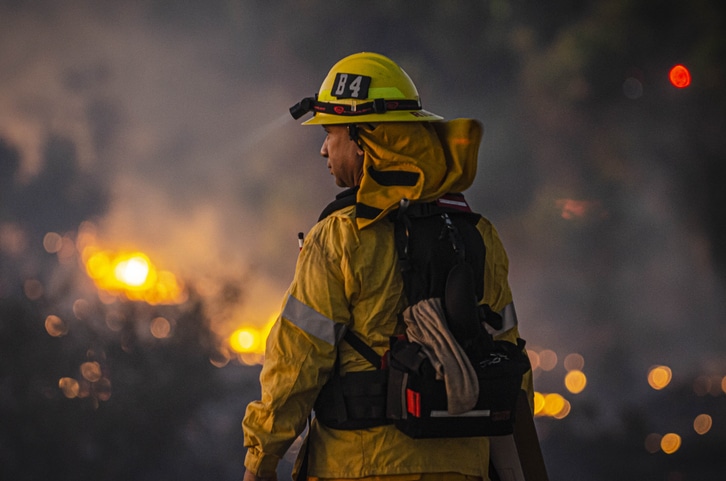
The Los Angeles Fire Department has added a new operational resource to reduce wildfire risk across the city. Known as Crew 4, the unit is the department’s first full-time paid wildland hand crew, created in response to increasingly destructive wildfire activity in Southern California.
On a recent day in the Sepulveda Basin near the Los Angeles River, crew members worked under shaded trees, cutting and removing dense vegetation. The area is prone to brush fires due to dense vegetation and homeless encampments. Using chainsaws and woodchippers, the team removed invasive trees and heavy brush to reduce fuel loads before fires ignite.
Crew 4 was formed following the Palisades Fire in January 2025, which was part of a series of 12 fires across the Los Angeles region. Those fires killed 31 people in the Altadena and Pacific Palisades communities and destroyed thousands of homes and structures. The Eaton and Palisades fires are now listed among the 10 deadliest wildfires in California history. The Palisades Fire alone burned more than 23,000 acres, destroyed thousands of structures, and began on Jan. 7, outside the traditional wildfire season.
According to the department, the crew strengthens both emergency response and year-round vegetation management. A large portion of Los Angeles falls within a very high fire hazard zone. During active fires, the crew digs fire lines and removes brush ahead of or along the fire’s edge. Before fires start, members focus on fuel reduction to limit ember spread during high-wind events, such as Santa Ana conditions.
Wildfire activity in California has expanded significantly in recent decades. The state Office of Environmental Health Hazard Assessment reports that both the area burned by wildfires and the number of large fires have increased, driven by land use changes, fire management practices, and climate conditions. Between 2020 and 2024, the annual average area burned statewide was about three times higher than during the 2010s.
Fire Chief Adam VanGerpen said wildfire risk in Southern California is no longer seasonal. Fires can occur year-round because of dry vegetation, low fuel moisture, and high winds. He cited the Palisades Fire as an example of a major wildfire that occurred outside the typical late spring through October window.
Crew 4 members completed five weeks of intensive training and graduated in June 2025. Since then, they have trained daily through physical conditioning, difficult terrain hikes across Los Angeles County, and frequent brush clearance work. The crew operates out of Fire Station 88 in the San Fernando Valley, which also serves as a training facility. The department said the team is becoming a central training resource for wildland fire operations.
The crew consists of more than 20 civilian wildland fire technicians, three sworn LAFD foremen, and a superintendent. The program was nearly two decades in the making. A volunteer hand crew program began in 2006, and officials advocated for a paid crew over the years. The department said the full-time model increases staffing consistency and overall capacity.
Officials said the crew is fully prepared to respond to wildfire incidents. Training has continued without interruption since late May and early June 2025, with a focus on coordinated response and safety.
Fire Chief Jamie Moore said lessons from the Palisades Fire are shaping how the department trains, prepares, and deploys resources, as well as how it works with communities. He said resident safety remains the department’s top priority.
Mayor Karen Bass said Crew 4 supports the city’s focus on both wildfire prevention and response. In a statement, she said investing in brush clearance and vegetation management plays a critical role in protecting communities while supporting response to fires and other all-hazard incidents.
Crew members come from a range of backgrounds, including prior volunteer service and other public safety roles. Some joined after responding to multiple fires across Los Angeles during January 2025. Others entered the program with limited wildland experience and completed the required training.
Department officials said having a dedicated hand crew allows the city to rely less on neighboring agencies during wildfire responses. Familiarity with local terrain and repeated training in the same environments also allows the crew to anticipate fire behavior and support suppression efforts more effectively.
Stay informed and ahead of the curve — explore more industry insights and program opportunities at ProgramBusiness.com.