









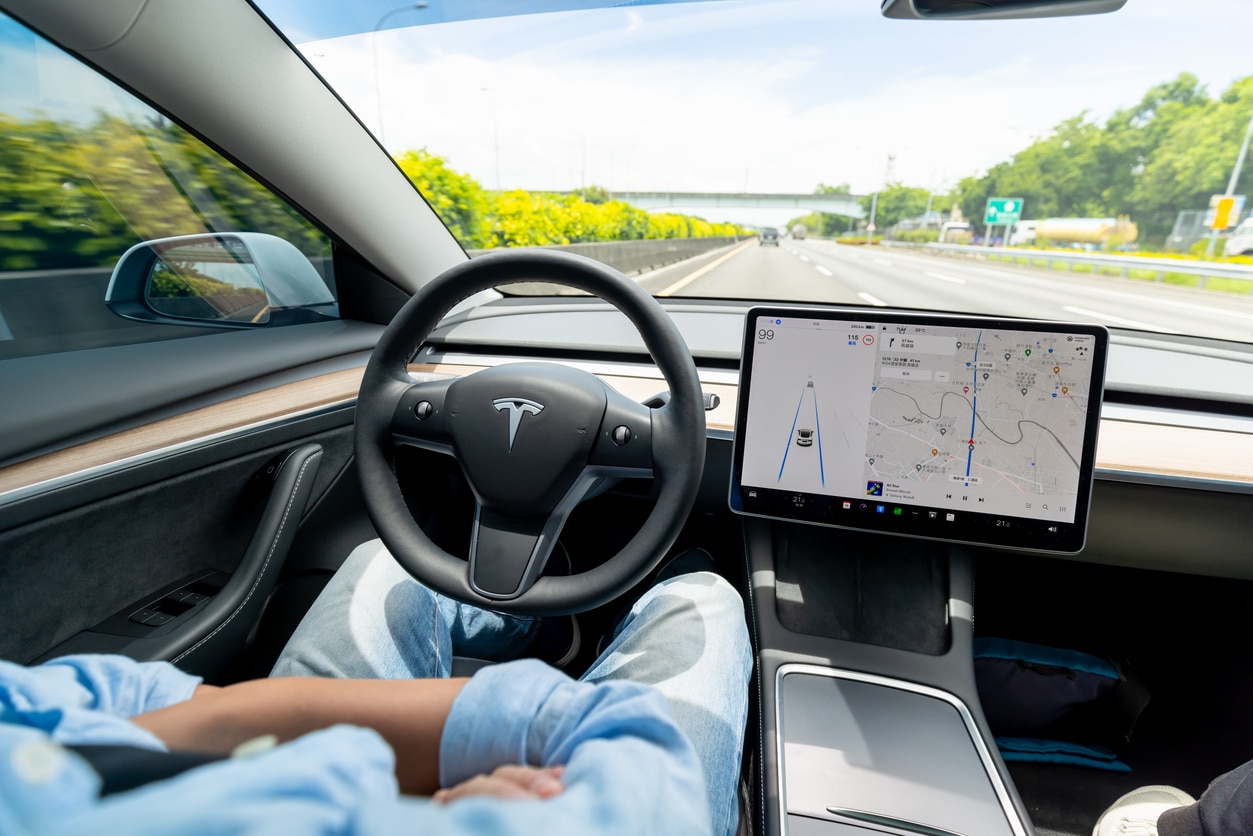
Tesla has introduced an update that directly links its Full Self-Driving (Supervised) technology to its in-house insurance product, further integrating vehicle performance data into premium calculations.
The company announced that its Safety Score 3.0 will automatically assign a perfect score of 100 to every mile driven with Full Self-Driving (Supervised) enabled. This adjustment is designed to increase drivers’ overall safety scores and reduce monthly insurance premiums.
Tesla Insurance currently uses real-time vehicle data, including acceleration, braking, following distance, and speed, to generate a Safety Score ranging from 0 to 100. Higher scores correspond to lower insurance rates. Under the previous scoring model, brief manual driving inputs could reduce a driver’s average score, even if most miles were driven in Full Self-Driving mode.
With the updated system, Tesla removes that penalty. Miles driven under supervised autonomous mode are now treated as the safest possible driving behavior within the scoring framework. As a result, drivers who rely more heavily on Full Self-Driving may see improved scores and lower premiums.
According to the company, the update responds to customer feedback. Some drivers had raised concerns that the earlier scoring model discouraged the use of Full Self-Driving by negatively affecting insurance outcomes.
The financial impact is positioned as immediate. Drivers who use Full Self-Driving for the majority of their trips may see their safety scores improve, potentially leading to lower annual insurance costs. Tesla has not provided specific figures for potential premium reductions.
The update also reflects a closer alignment between Tesla’s autonomous technology and its insurance offering. By tying premium pricing to data collected during Full Self-Driving use, Tesla is relying on its internal driving data rather than traditional external crash statistics alone.
At launch, the updated Safety Score model applies only to new Tesla Insurance policies in six states: Indiana, Tennessee, Texas, Arizona, Virginia, and Illinois. Existing policyholders are not yet included. The limited rollout has prompted questions from Tesla owners in other states, including California and Georgia, about when the program may expand.
Tesla has not shared a timeline for broader availability. However, the update arrives as the company continues to expand its Full Self-Driving capabilities and seek regulatory approval for more advanced autonomous features.
The integration of Full Self-Driving data into insurance pricing establishes a direct relationship between autonomous driving usage and insurance premiums. Each mile driven under the system now carries a defined financial impact, based on Tesla’s internal risk assessment.
Stay informed and ahead of the curve — explore more industry insights and program opportunities at ProgramBusiness.com.