












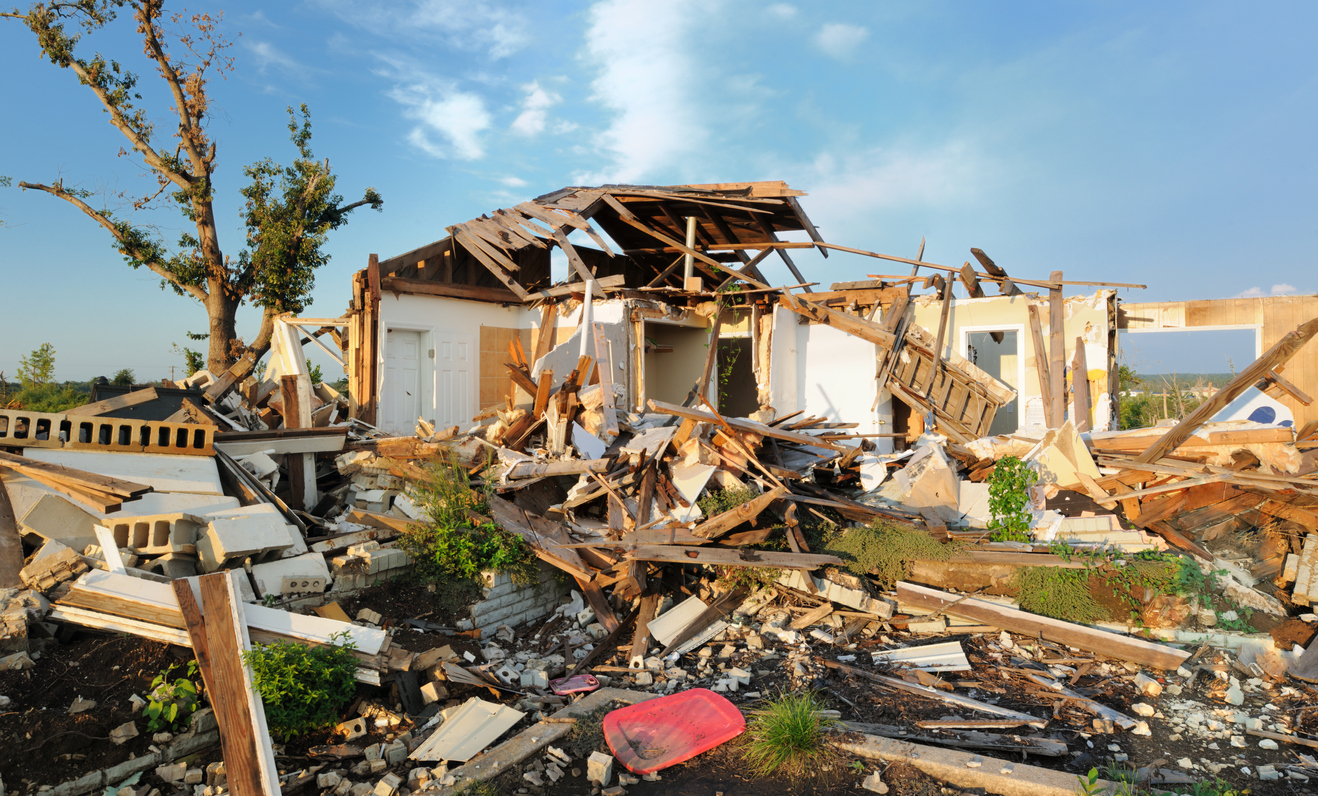
According to the Federal Emergency Management Agency, safe rooms provide "near-absolute protection" during a tornado. A small shelter in a commercial building can cost as little as $15,000 and could have saved the six workers killed when a tornado destroyed the Amazon warehouse in Edwardsville, Ill., two weeks ago.
The 2012 proposal, however, was thwarted by a little-known organization that establishes building codes widely used by states and cities across the country. The International Code Council is comprised of state and local code officials from across the country. The proposal was withdrawn before it could be voted on by a council committee comprised of representatives from the building industry and local code officials. The committee determined that the safe room proposal from 2012 was "overly restrictive and contained several technical flaws."
While experts claim that the technology and design standards exist to better protect people and buildings from tornadoes, attempts to incorporate those designs into building codes have been repeatedly blocked or limited by the building industry, according to public documents and people involved in efforts to tighten the model codes.
"It really does come down to money," said Jason Thompson, vice president of engineering at the National Concrete Masonry Association and one of the 2012 change's proponents. "There are various groups out there that want to keep construction costs as low as possible."
The stakes are increasing. Tornadoes, long associated with Oklahoma, Kansas, and other sparsely populated Plains states, appear to be shifting eastward, occurring more frequently in states such as Kentucky and Tennessee, according to Victor Gensini, a professor in Northern Illinois University's department of geographic and atmospheric sciences.
Although scientists lack the data to definitively link tornadoes to climate change, he believes that a warming planet is producing more humid air near the Earth's surface, which may be fueling more tornadoes. And it's putting more people in danger. "The population density increases exponentially east of the Mississippi River," Dr. Gensini said.
'It's completely inappropriate.'
In the United States, building codes are the responsibility of the state. Moreover, rather than having each state create its own building codes from scratch, the International Code Council publishes a set of model codes for residential and commercial building, plumbing, electrical, and even wildfire safety. The codes can then be adopted by states, with modifications as needed.
Every three years, the council's model codes are updated to reflect advances in engineering science. Members of the council must approve proposed changes.
However, before those proposals can be voted on, they must first be approved by committees comprised of industry representatives. This step is intended to eliminate ideas that experts believe are poorly thought out or difficult to implement. The process is designed to ensure that only changes that have broad support advance.
However, it also provides an opportunity for industry to obstruct changes that may increase their costs. According to Jim Bell, director of operations for the National Storm Shelter Association, adding a safe room can cost anywhere from $7,000 for a house to $100,000 for a version that holds about 100 people in a commercial building.
The 2012 safe room proposal was introduced by the Insurance Institute for Business & Home Safety, a research group supported by the insurance industry that studies changes in building construction that can reduce damage during storms, fires, and other disasters and then advocates for those changes to be implemented. It was joined by cement industry trade associations, whose members stood to benefit from increased demand for safe rooms.
However, according to a video recording of the hearing, representatives of the building industry lined up to oppose the proposal at a hearing before the committee that would decide whether the proposal would advance to a vote by the council.
"It's completely inappropriate," said Ron Burton, who worked for the Building Owners and Managers Association at the time and had previously oversaw codes and standards at the National Association of Home Builders.
"I'm concerned that this isn't the solution," said Jonathan Humble, the American Iron and Steel Institute's director of construction codes and standards.
"It's far too soon to have a knee-jerk reaction," said Chad Beebe, an American Hospital Association official.
The proposal was defeated by the committee. It approved a more stringent requirement for safe rooms in most new schools, as well as in emergency facilities such as police stations and 911 call centers.
Craig Fugate, the FEMA administrator at the time, described the code-development process as a never-ending battle between safety advocates advocating for better design in the face of disasters and developers seeking less red tape.
"A lot of building codes in this country are based on hope: we just hope it's not that bad," Mr. Fugate explained. "And people perish."
The ability to halt code changes
The idea of mandating safe rooms became more popular in 2014, when the National Institute of Standards and Technology, a branch of the Department of Commerce, released a report on the 2011 Joplin tornado. It advocated for the installation of tornado shelters in new and existing multifamily residential buildings, commercial buildings, schools, and other high-risk structures.
According to Marc Levitan, a tornado researcher at the institute and the lead investigator for the Joplin report, the national institute initially planned to push for that recommendation to be incorporated into model building codes.
Those plans piqued the interest of the home building industry, which wields significant clout in the code-development process and boasted to members one year that only 6% of the proposals it opposed made it past the committee stage.
The National Association of Home Builders has over 140,000 members and typically opposes changes that would raise the cost of housing. According to Stephen Skalko, an engineer who worked for the Portland Cement Association at the time and was one of the people who introduced the idea of requiring safe rooms, it had opposed the safe room requirement proposed in 2012.
The home builders association informed its members in September 2014 that the national institute and FEMA intended to lobby the council to require safe rooms in new and existing apartment buildings, businesses, schools, and other large buildings in tornado-prone areas.
Instead, the council expanded the requirement for safe rooms in schools to include additions to existing buildings.
"After discussions with many of the key stakeholders," Dr. Levitan explained via email, "it was clear that an iterative process over time would garner more support and be more likely to succeed." He refused to name the stakeholders who had expressed concern.
Elizabeth Thompson, a spokeswoman for the builders' association, declined to comment on specific proposals. She provided a statement from the group's chairman, Chuck Fowke.
Mr. Fowke stated, "NAHB strongly supports building codes that result in safe, decent, and affordable housing." "We will continue to advocate for low-cost, common-sense building codes that promote housing affordability while also making new homes safer and more efficient."
'It's more of a political issue than anything else.'
Even as the push to require safe rooms in a wide range of buildings faded, engineers were working on an even more ambitious goal: changing the way buildings in tornado zones are designed and built to withstand all but the most violent storms.
According to Don Scott, who has helped develop tornado-resilient building standards at the American Society of Civil Engineers, designing a structure to withstand tornado winds consists of two basic steps. To begin, the roof must be tightly secured to the walls, and the walls to the foundation, in order to transfer the tornado's pressure downward to the strongest part of the building.
Second, windows and other openings must be strong enough to withstand the debris thrown through the air at high speeds during a tornado, such as tree limbs. If a window breaks, the tornado's wind pressure is forced into the building, "like blowing up a balloon," according to Mr. Scott. He claims that covering windows with a special glaze can keep them from shattering, similar to hurricane-resistant windows in Florida.
Mr. Scott and his colleagues at the civil engineering society set about translating the findings of the National Institute of Standards and Technology's Joplin report into building requirements that would be incorporated into the next version of the model building code, which would be published in 2024.
The construction industry, too, was successful in narrowing those goals.
Stronger design standards and impact-resistant windows, according to Mr. Scott, work for any type of structure. However, as the engineering society got started, Mr. Scott said he received a warning from Gary Ehrlich, the head of standards at the National Association of Home Builders: If Mr. Scott's group recommended applying those standards to homes, the recommendations would never make it into the model codes.
Ms. Thompson, a spokeswoman for the home builders' association, said Mr. Ehrlich was unavailable for comment.
Tornado-resistant building standards, according to evidence, do not significantly increase the cost of a home. Following the devastation caused by a tornado in Moore, Oklahoma, in 2013, the city enacted new regulations to reduce damage from future tornadoes. According to Elizabeth Weitman, the city's community development director, these changes added about $3,000 to the cost of a new home.
"It's well worth the money," said Ms. Weitman.
Nonetheless, the American Society of Civil Engineers chose to be cautious. When the new tornado standards were released on December 1, they only applied to a specific group of buildings, including hospitals, fire stations, and police stations.
Apartment buildings, warehouses, most manufacturing plants, and houses are not included. Mr. Scott expressed hope that this would happen in the future.
"It's more of a political issue than anything else," Mr. Scott explained. "Many different building code organizations do not want to raise the cost of a home."