











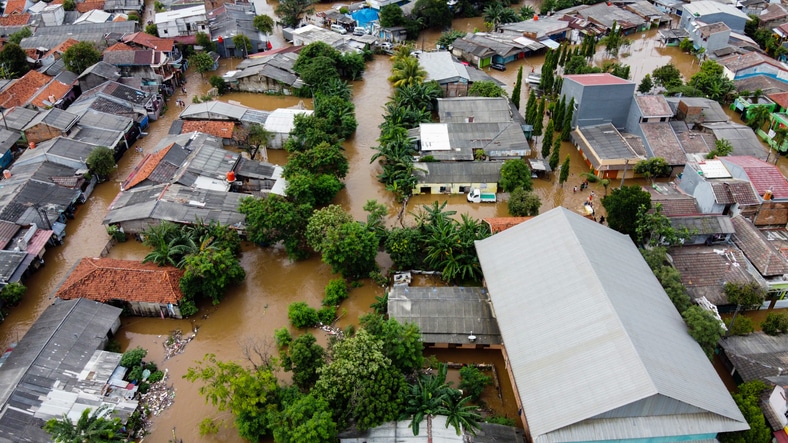
The U.S. National Flood Insurance Program is more than $20 billion in debt as flood events increase in frequency and geographic reach. At the same time, researchers say outdated flood prediction methods are compounding financial strain on the program and exposing property owners to greater risk.
Arizona State University researcher Upmanu Lall and a team of collaborators recently published two studies examining the causes behind the National Flood Insurance Program’s financial challenges and potential structural updates. Adam Nayak, a PhD student at Columbia University, led the studies.
In the first study, researchers examined prolonged, large-scale weather events that cause flood damage across entire regions. They identified a pattern they termed “hyperclustering.” According to the study, hyperclustered events represent the largest driver of national flood insurance debt. These events include hurricanes and multi-week storms that trigger widespread flooding and a surge of simultaneous insurance claims.
In the second study, the team analyzed millions of insurance claims, disaster aid records, and property buyouts. Their analysis found that most U.S. flood losses stem from more common rainfall events that occur once every five to 20 years. Researchers noted that many insurance payouts occur every five to 10 years, reflecting annual flood probabilities of 10% to 20%.
The NFIP has operated since 1968 as a federally subsidized program. Homeowners with mortgages in designated 100-year floodplains must carry flood insurance. A 100-year floodplain refers to an area with a 1% annual chance of flooding, as determined by Federal Emergency Management Agency flood maps based on historical river and coastal data.
However, researchers pointed out that flood risk varies within mapped zones. While the boundary of a 100-year floodplain reflects a 1% annual probability, properties located deeper within the zone may face significantly higher annual risks. As a result, the designation can mask the frequency and severity of actual flood exposure.
Meanwhile, financial losses from storms and flooding have risen. The eight largest national flood insurance payouts have occurred within the past 21 years, placing sustained pressure on the NFIP’s finances.
Lall, director of the ASU Water Institute in the Julie Ann Wrigley Global Futures Laboratory and a professor in the School of Complex Adaptive Systems, said that future climate projections, migration trends, and new housing development patterns suggest the problem could intensify.
To address these trends, researchers recommend revising flood risk assessment models. They argue that FEMA flood maps should incorporate additional variables such as climate trends, population growth in flood-prone areas, and aging infrastructure. Including broader context in modeling could improve insurance pricing and inform development decisions.
The team also examined structural alternatives to the current system. Some policymakers have proposed replacing the NFIP with separate state-based programs. Researchers found that while such a shift could benefit states with limited flood exposure, it could significantly increase coverage costs in flood-prone states. In addition, state programs may become insolvent sooner because they do not distribute risk across a national pool.
Instead, the researchers propose creating multistate catastrophe bonds or secondary insurance mechanisms to address hyperclustered events. These instruments would distribute both funds and risk among participating states to supplement existing programs.
The team also recommends evaluating all sources of financial risk reduction collectively, including property buyouts, disaster declarations, insurance subsidies, and private-market catastrophe bonds. They suggest that coordinated redesign of the NFIP, disaster declaration funding, and buyout programs, along with state and community cofunding and private-market participation, could improve risk pricing and liquidity management.
Lall’s research received partial support from the Institute for Geospatial Understanding through an Integrative Discovery Environment, funded by the National Science Foundation under award number 2118329. Nayak received support from a National Science Foundation Graduate Research Fellowship. The School of Complex Adaptive Systems is part of the Rob Walton College of Global Futures.
Get the latest insurance market updates and discover exclusive program opportunities at ProgramBusiness.com.