











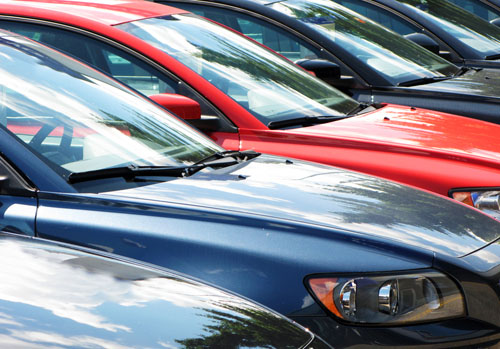
According to new data released Monday by research firm S&P Global Mobility, the average vehicle age in the United States increased for the fifth consecutive year.
Analysts say that over the last two decades, vehicles in the United States have gotten older on average as quality has improved and cars have lasted longer.
According to S&P Global Mobility, the trend has only accelerated during the pandemic, owing to a computer-chip shortage that has reduced factory output and left dealership lots bare.
With car supplies limited, prices on both new and used vehicles have risen, causing more shoppers to postpone purchases. According to the firm, the average vehicle age will surpass 12 years for the first time in 2020.
"You can't find a reasonable replacement," Todd Campau, associate director of aftermarket solutions at S&P Global Mobility, said.
According to S&P Global Mobility, the percentage of cars and trucks scrapped (or taken out of service) each year has fallen to a two-decade low of 4.2 percent in 2021.
Meanwhile, drivers are putting more miles on their vehicles as they resume driving after a period of lockdowns and travel restrictions during the early days of the Covid-19 crisis. According to S&P Global Mobility, light vehicles in the United States traveled an average of 12,300 miles last year, a 10% increase from 2020.
Trina McCray is one of those who is hesitant to part with her current vehicle, a 2014 Toyota Avalon that recently required a $1,200 alternator repair. The Florida resident said she considered replacing it with a similar model, but changed her mind after seeing the high prices dealers were charging.
"I just decided it wasn't worth it to try to find something," Ms. McCray explained.
According to the firm, the upward pressure on vehicle ages could last through this year and into 2023. The auto industry is still dealing with a number of challenges that are preventing car companies from restocking selling lots, including a computer-chip shortage that is expected to last another year and more recent supply-chain disruptions linked to the Russia-Ukraine crisis, according to the report.
New-vehicle prices are also rising, with auto executives warning that an inventory shortage on selling lots could last into next year. According to J.D. Power, the average price paid in April 2021 for a new 2021 model-year vehicle was $38,585. Nine months later, in January 2022, the same model-year vehicle was selling for an average of $48,765 as a slightly used vehicle.
Buyers are also paying near-record prices for used vehicles, though in recent months they have begun to see some relief as transaction prices have begun to soften after a long period of steady increases.
"Right now, there is no horizon where I can say we're going to reach that inflection point and begin to fall," Mr. Campau said of the average vehicle age. He also stated that during economic downturns, buyers tend to hold onto vehicles for longer periods of time, a trend that was also observed during the 2008-2009 financial crisis.
While the average age of vehicles is increasing, there is one segment of the car market where the average age is decreasing: electric vehicles. According to S&P Global Mobility, the average age of an EV in 2021 was 3.8 years, down from 3.9 years in 2020. More widespread adoption of electric vehicles could potentially reduce the average American car's age, but Mr. Campau believes that change will not be noticeable until the next decade.
For the time being, the need to repair and maintain these aging vehicles is driving more business to repair shops, he says.
According to Xtime, a software-focused brand under Cox Automotive that tracks this data, the average revenue per service visit hit a record of $514 in April. This is roughly 30% higher than the $394 per-service transaction recorded in January 2018, when Xtime began collecting data.
Bobby Colemire, owner of Crowes Master Tech Auto Repair in Lexington, Kentucky, said he has seen a significant increase in demand for service work and has had to hire more people as a result. Customers facing costly repairs prior to the pandemic would frequently put that money toward a new vehicle, he added.
"We're getting a lot fewer price-based refusals now," Mr. Colemire said.