












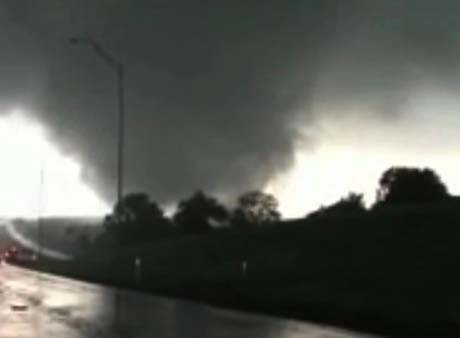
According to a study presented Monday at the American Geophysical Union conference, the combination of a longer and wider track with slightly stronger winds means that some rare winter tornadoes that are deadly now will have nine times the power by the end of the century if carbon dioxide levels continue to rise.
The study, which predates the devastating Mayfield, Kentucky, tornado outbreak, focuses on the strength of large tornadoes rather than their frequency as climate change progresses. Although it had not yet been peer reviewed, it was presented as a poster as a sneak peek at new research that would be published later.
"There is a potential for events in the future that are more intense that would not have been as intense in the current climate," said study author Jeff Trapp, head of atmospheric sciences at the University of Illinois, Urbana-Champaign. "Bearing in mind that these high-end events are still going to be rare."
Trapp used the conditions from two large tornado strikes in 2013 —- the Hattiesburg, Mississippi, tornado that injured 82 people with winds of 170 mph in February of that year and the Moore, Oklahoma, tornado that killed 24 people with winds up to 210 mph (340 kph) in May —- and ran them through dozens of computer simulations of worst-case climate change scenarios by 2100, which other scientists say is increasingly unlikely.
The worst-case scenario, which the world was on track for, would see another 6 degrees Celsius (3.3 degrees Fahrenheit) of warming between now and the end of the century. Trapp stated that he will soon run simulations based on a scenario for carbon dioxide emissions closer to the current trajectory of about 3.2 degrees (1.8 degrees Celsius) warming above current levels.
Trapp discovered a significant change on the winter storm, significantly longer and wider tracks, and windspeed increases of around 14 percent, which added up to a nine-fold increase in power when using a formula that considers wind speed, rotation, and path size. According to him, power increased 1.5 times during the spring storm.
Trapp explained that this is due to the fact that tornadoes require two key ingredients: unstable stormy weather and wind shear. Wind shear, or the difference between winds up high and winds near the ground, is usually stronger in the winter, but there is less stormy weather because stormy weather requires warm, humid conditions near the ground. However, he believes that as the world warms, there will be more opportunities for winter instability.
Three outside scientists said the study may have some validity, but they aren't completely convinced.
"I'm not 100% sold on the technique, but it's a very interesting approach," said Harold Brooks, a scientist at the National Severe Storms Laboratory in Norman, Oklahoma. "To me the really interesting result seems to be the longer-tracks for the cool season."
"One of the major components to Friday's outbreak was the broad and anomalous warm (swath of temperatures), which allowed the storm to last for what will likely be a record-breaking path length," said Northern Illinois University meteorology professor Victor Gensini.