












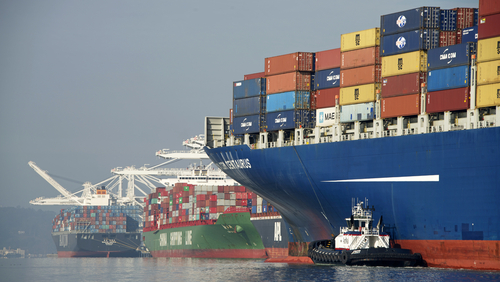
Transportation and logistics providers are looking for significant price increases for contracts in the coming year, indicating that the inflationary pressure caused by high demand and limited capacity in freight markets is likely to persist.
With high shipping demand still outweighing tight capacity in the freight sector, industry experts say transport operators have negotiating power to raise prices when negotiating new contracts. Ocean-shipping executives predict that rates set in many annual contracts will more than double from earlier this year, before supply-chain bottlenecks squeezed capacity. Contract rates are expected to rise by double digits in 2022, according to some trucking companies.
Prices in the freight sector have been rising across the board, including in parcel delivery, trucking, ocean shipping, and warehousing. Although many large shippers may have multiyear agreements with a variety of carriers, most freight-transportation contracts are negotiated annually.
"I think people are a little shell-shocked right now," said Todd Bulmash, a logistics executive and Council of Supply Chain Management Professionals board member. "They're bracing themselves for the worst."
Most freight transport and logistics markets have pricing that oscillates between relatively stable long-term contract rates and spot-market pricing that is more sensitive to shifts in demand and capacity availability. Spot market prices for ocean shipping, trucking, and other logistics services have risen dramatically this year.
According to Cass Information Systems Inc., which handles freight payments for businesses, domestic shipping rates for moving goods by road and rail in the United States are up about 23 percent this year compared to 2020.
A separate measure in the Logistics Managers' Index that tracks overall logistics prices, including transportation, warehousing, and inventory prices, set a new high in November, rising 3.4 percent from October and 14 percent year on year. The index was first published in 2016.
Trucking companies and other logistics companies have noted their own higher costs, including rising wages as they sought workers in a tight labor market.
"As long as there is underlying inflation in the economy, you will see that inflation reflected in the cost of goods and services, including trucking," said Derek Leathers, CEO of Omaha-based truckload carrier Werner Enterprises Inc.
Mr. Leathers, who predicts that contract rates will rise by high single-digit to mid-double-digit percentages in 2022, believes that price increases will moderate as transportation demand eases and companies finish replenishing depleted inventories. "We don't foresee that until 2023," he said. We anticipate a capacity-constrained market with inflationary pressures and significant equipment disruptions throughout 2022."
Close-to-consumer parcel-shipping prices are rising at the fastest rate in nearly a decade, as pandemic-driven demand shifts pricing power to carriers that deliver packages to homes and businesses. FedEx Corp. and United Parcel Service Inc. both announced that rates would rise an average of 5.9 percent across most services next year, the first time in eight years that either company had annual increases above 4.9 percent.
According to Xeneta, a transportation data and procurement specialist based in Norway, prices to ship sea containers are likely to set new records under annual contracts typically negotiated early in the year for the peak shipping season.
According to Xeneta, the spot price for shipping a 40-foot container from Shanghai to Los Angeles earlier this month was 75% higher than at the same time last year. Carriers "go into contract negotiations right now with the lion's share of the aces," according to Xeneta's chief analyst, Peter Sand.
Seko Logistics, an Itasca, Ill.-based freight forwarder, says its contracted rate to ship a 40-foot container from Asia to the West Coast of the United States could double to between $6,500 and $7,500 next year. In 2019, the company paid about $1,500 to ocean carriers for the same service.
"The carriers are completely in charge, and the rest of us are sitting on our hands waiting for the carriers to tell us what to do," said Craig Grossgart, Seko's senior vice president of global ocean freight.
According to Gordon Downes, CEO of New York Shipping Exchange Inc., which monitors and enforces ocean contracts, talks between some carriers and customers have already begun, rather than waiting until the new year, because shippers who waited until the last minute during the previous negotiating period discovered carriers had already run out of space.
The outlook for higher rates in trucking for next year follows a sharp increase in the contract prices that businesses negotiate with trucking companies and freight brokers. According to online freight marketplace DAT Solutions LLC, the average contract rate reached a record $2.51 per mile excluding fuel surcharge last month.
To avoid competing for scarce trucking capacity on the open market, some retailers and manufacturers are extending existing contracts with carriers through 2022 in exchange for modest price increases, according to Chris Caplice, chief scientist at DAT and executive director of the Massachusetts Institute of Technology's Center for Transportation and Logistics. "You can expect your rates to be 10% to 15% higher on average if you go out to bid," Dr. Caplice said.
The cost of storing goods is also expected to rise faster as warehouse labor costs rise and facility owners seek price increases to replace expiring leases that allowed businesses to avoid sharply rising rents in 2021.
Lease prices for industrial properties have increased by 25% on average nationwide compared to rates tenants paid at the end of five-year leases that expired in the third quarter, according to real-estate firm CBRE Group Inc. in early December.
According to Carolyn Salzer, head of industrial and logistics research in the Americas at real-estate firm Cushman & Wakefield, landlords are even hesitant to agree to new long-term leases that bake in current market rates, reasoning that tight capacity will lead to rising prices in the coming years. "Rents are going to be higher in five years," she predicted. "So it's in the investor owners' best interests to do a short-term lease right now."
Third-party logistics providers that provide outsourced distribution and fulfillment services are also passing on higher labor costs to their customers as warehouse worker competition drives up wages.
Shippers are experimenting with different methods to combat transportation inflation, such as consolidating more loads to reduce truck trips and renting truck trailers for storage rather than paying rising warehousing rents.
However, experts believe that businesses have little choice but to absorb the cost or pass it on to their customers.
According to Satish Jindel, president of SJ Consulting Group Inc., transportation costs rarely exceed 7% of the cost of the goods being shipped. Mr. Jindel stated that "the value of the product you're selling and the importance of that sale is much greater than a slight increase in transportation costs" for most businesses. "You don't want to say you lost a sale because you were looking for a less expensive way to get it there."