











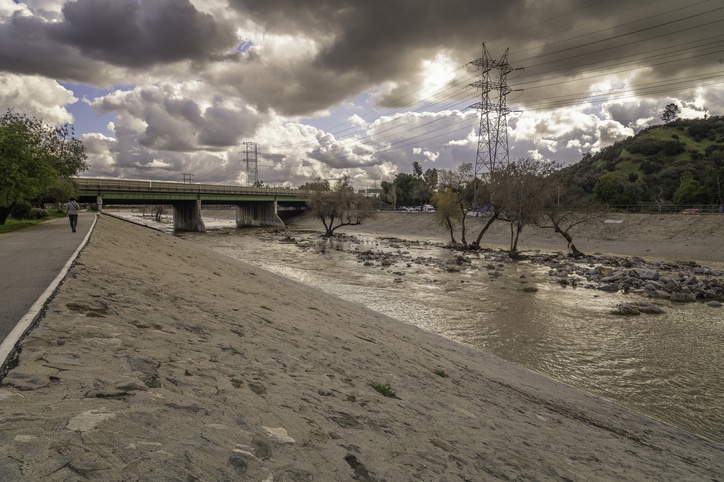
In recent weeks, powerful atmospheric river storms moved across Washington, Oregon, and California, bringing intense rainfall and causing rivers to surge beyond their banks. As water levels rose, multiple levees overtopped or breached, triggering evacuations and flooding in nearby communities. These events have drawn renewed attention to the condition of the nation’s levee system and the risks it now faces.
Levees often operate out of public view, performing their function quietly year after year. However, during extreme weather, their role becomes immediate and personal. Whether a levee holds or fails can determine whether homes, businesses, and critical infrastructure remain protected or become inundated.
The recent damage in the western United States reflects a broader, long-standing issue. Across the country, levees are aging while weather patterns are becoming more extreme. Many existing structures were not designed to manage the scale or intensity of the conditions they now encounter.
How Levees Became Critical Infrastructure
Many levees in use today were not originally built as part of comprehensive flood control systems. Decades ago, farmers constructed simple earthen embankments to protect crops and livestock from seasonal flooding. These early structures relied on practical experience rather than formal engineering standards and often lacked consistent construction or maintenance practices.
Over time, surrounding land use changed. Agricultural areas transitioned into residential neighborhoods, industrial sites, transportation corridors, and ports. As populations expanded into floodplains, these modest embankments became primary flood defenses for millions of people. This shift occurred largely without coordinated planning or public debate about whether the levees were suitable for their expanded role.
Scope and Condition of the U.S. Levee System
According to the National Levee Database, the United States has more than 24,000 miles of levees, with an average age of approximately 61 years. Collectively, they protect more than 23 million people, about 7 million buildings, and nearly $2 trillion in property value.
Oversight and maintenance vary widely. Some levees receive regular inspections and upgrades, while others are managed by small local agencies or private owners with limited resources. In certain cases, responsibility for upkeep is unclear or divided among multiple entities.
During storms in mid-December 2025, a levee along Washington state’s Green River breached after years of delayed repairs. Disagreements among government agencies had postponed the work, and the breach ultimately forced thousands of residents to evacuate. Incidents like this underscore how governance and funding challenges can affect levee performance.
The American Society of Civil Engineers’ 2025 Report Card for American Infrastructure assigned the nation’s levees a D-plus grade, citing aging infrastructure, inconsistent monitoring, and long-term underinvestment. Data collected over the past 15 years show nearly 500 cases of overtopping, when water flows over the top of a levee. While this does not indicate widespread failure, it does show that many levees operate with limited safety margins.
How Levee Failures Occur
Levee failures typically develop gradually rather than as sudden collapses. Overtopping is the most common cause. When water flows over a levee, it can erode the landward side, weakening the structure from behind. A small amount of erosion can quickly expand into a breach, allowing large volumes of water to pass through.
Atmospheric river storms increase this risk by delivering heavy rainfall over broad areas in short periods, often combined with snowmelt. Rivers can rise rapidly and remain elevated for extended durations. Many levees were not designed to withstand such prolonged pressure.
When breaches occur, flooding can be swift and deep, limiting evacuation time and causing damage that extends well beyond the immediate floodplain.
Communities Reliant on Levees
Millions of people live and work in areas protected by levees, often without being fully aware of their presence. Residential neighborhoods, schools, highways, rail lines, ports, and energy facilities all depend on levee performance.
Research indicates that urban development in floodplains often accelerates after levees are built. In some cases, growth occurred at more than twice the rate seen in nearby counties without levees. This expansion can influence how communities perceive flood risk.
When levees fail, flooding can be more severe than in areas without them. Water may rush in quickly and drain slowly, compounding damage. The risks are not evenly distributed. Historical investment patterns, economic factors, and policy decisions have shaped which communities rely on older or less robust levee systems.
This disparity was evident during a March 2023 atmospheric river event in California, when a levee along the Pajaro River failed and flooded the town of Pajaro. The community includes many low-income farmworkers. Floodwaters forced evacuations, and some residents became trapped as water levels rose. Subsequent reporting showed that engineers and officials had documented the levee’s vulnerabilities for decades, but repairs were repeatedly delayed, in part due to funding priorities.
Similar patterns appear nationwide. Disadvantaged communities and communities of color are more likely to depend on older levees or those outside major federal programs. Rural areas may rely on agricultural levees, while urban neighborhoods may depend on structures built for smaller populations. When failures occur, impacts can include road closures, power outages, water contamination, and long-term disruption.
Why the Current Moment Matters
Engineering methods, monitoring tools, and risk assessment practices have improved over time. Hurricane Katrina in 2005 marked a significant turning point, exposing the consequences of fragmented responsibility and deferred maintenance after levee failures led to widespread flooding in New Orleans.
Since then, federal investments, particularly through agencies such as the U.S. Army Corps of Engineers, have strengthened the management and condition of many levees. However, decisions made decades ago continue to influence present-day risk.
Climate-related factors are adding further pressure. Heavier rainfall, rapid snowmelt, and rising sea levels are pushing water control systems beyond original design assumptions. Events once considered rare are occurring more frequently.
As atmospheric river storms continue to test levees in the West and flood risks grow nationwide, understanding the history, condition, and limitations of levee systems remains essential for assessing exposure and resilience across the insurance and infrastructure landscape.
Stay informed and ahead of the curve — explore more industry insights and program opportunities at ProgramBusiness.com.