











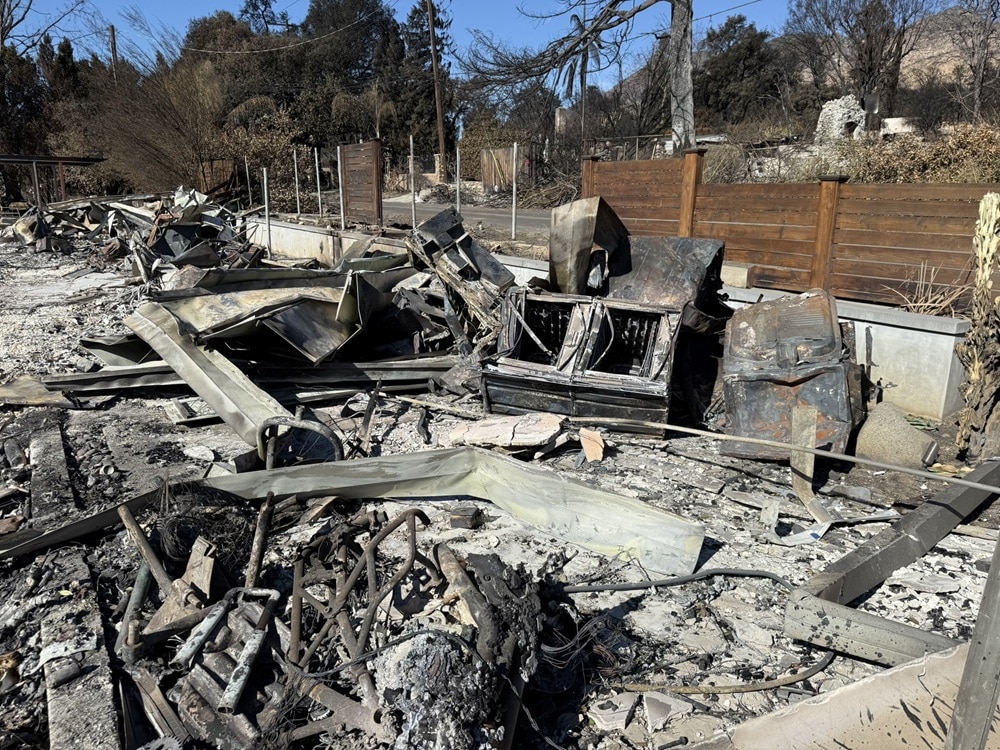
In recent years, many catastrophic fires have been classified as “wildfires.” But two major California events — the Eaton and Palisades Fires — revealed a critical truth: much of the destruction wasn’t caused by burning vegetation. Instead, the fires evolved into wildfire-induced conflagrations, where the primary fuel shifted from forests and brush to homes, buildings, and other man-made structures.
This transition changes how a fire behaves, spreads, and devastates communities — and it also changes how risk must be evaluated. Cotality’s latest analysis of these two events demonstrates that traditional wildfire hazard scoring alone is no longer enough to accurately assess exposure.
When Wildfires Turn Urban: Understanding Conflagration Exposure
A wildfire-induced conflagration occurs when a fire transitions into structure-to-structure ignition. At this stage, factors like building density, construction characteristics, ember travel, wind speed, and urban design become bigger drivers of destruction than vegetation.
These conditions often arise beyond the traditional “wildfire hazard zones,” putting properties previously considered safer at unexpectedly high risk.
Eaton Fire: Low Wildfire Hazard, High Destruction
The Eaton Fire (January 7–21, 2025) burned through more than 9,000 properties — over 6,600 of which were damaged or destroyed. Traditional wildfire models would have overlooked most of them:
| Wildfire Risk Score (Pre-Event) | Properties in Eaton Perimeter |
|---|---|
| Low | ~71% |
| Moderate | ~9% |
| High | ~11% |
| Very High | ~10% |
Yet, Cotality’s Wildfire Conflagration Score told a very different story. Pre-event, about 93% of properties were rated high or very high conflagration hazard, and an estimated 75% were simultaneously low-to-moderate wildfire hazard but high conflagration hazard.
This explains how a region with largely “low wildfire risk” suffered massive losses — the fire transitioned into a conflagration and spread rapidly through densely built environments.
Palisades Fire: Different Vegetation, Similar Outcome
The Palisades Fire showed a more balanced wildfire hazard spread, with vegetation-driven risk playing a larger role:
| Wildfire Risk Score (Pre-Event) | Properties in Palisades Perimeter |
|---|---|
| Low | ~33% |
| Moderate | ~12% |
| High | ~18% |
| Very High | ~37% |
Even here, low wildfire risk did not equal safety. Cotality estimated that 37% of affected properties were low-to-moderate wildfire hazard but high-to-very high conflagration hazard — threatening nearly 4,000 structures.
After the fire, nearly 48% of destroyed properties had been classified as low-to-moderate wildfire risk but showed high conflagration exposure.
By combining its Wildfire Risk Score and Wildfire Conflagration Score, Cotality successfully identified 85% of properties that were ultimately impacted.
Why Dual Hazard Scoring Is Now Essential
| Risk Factor | Traditional Wildfire Models | Conflagration Models |
|---|---|---|
| Vegetation exposure | ✔️ | ➖ |
| Urban building density | ➖ | ✔️ |
| Ember-driven ignition | Limited | ✔️ |
| Structure-to-structure fire | ➖ | ✔️ |
| Wind-driven spread in urban zones | Limited | ✔️ |
Conclusion: Evaluating properties solely through a wildfire hazard lens overlooks the now-common transition to urban conflagration.
The Broader Pattern: A Nationwide Concern
Since 2020, 10 wildfire-induced conflagration events have destroyed more than 26,000 structures, including the Lahaina, Hawaii (2023), and Marshall, Colorado (2021) fires.
This risk is not just a California issue. In San Diego County alone, traditional wildfire models classify about 84% of properties as low wildfire risk, yet Cotality’s Wildfire Conflagration Model reveals that 14% face elevated conflagration risk — exposure that would go undetected using wildfire metrics alone.
Looking Ahead
Cotality’s analysis proves that wildfire and conflagration hazards must be modeled separately — and evaluated together — to capture the full extent of property-level exposure. As wildfire-induced urban firestorms become more frequent, carriers and risk managers who rely solely on conventional wildfire scoring may underestimate hidden risks across their portfolios. Learn more at Cotality.
Stay informed and ahead of the curve — explore more industry insights and program opportunities at ProgramBusiness.com.